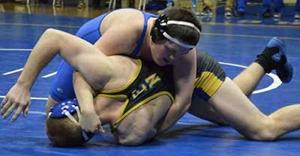
By Kassie Barroquillo from KPC News.com:KENDALLVILLE — Despite losing to Columbia City, 40-29, Wednesday, East Noble ended its senior night with a cheering crowd, a trophy, and an excited team — all thanks to a wrestler who has become the heart of the squad.
Senior John Herron pinned fellow senior Jake Weimer in an exhibition match immediately following the end of the Knights’ varsity meet. He has been on the wrestling team for three years. Herron has been the recipient of the team spirit award for the past two years; he is always one of the loudest people cheering for his teammates; and he has Down Syndrome.“He’s got all of the qualities everybody wants. He’s so supportive of us,” said EN coach Keith Hoffar. “It has been a privilege and I think the kids think so too.”
Assistant coach Ryan Pepple, who planned the exhibition match, said, “I wanted to give him the same experience as his teammates.”
Rules are also meant to be broken -- that's what a lot of other people say. But what are rules, really? Rules -- particularly in sports -- are meant to keep people safe. They're in place to even the playing field and to allow each person, place or thing involved a fair shot.
Eric Dompierre wasn't born with an even playing field -- he was born with Down Syndrome. but he doesn't go home after school at Ishpeming High School to lament his handicap, he goes to basketball practice. At least he used to, according to UpperMichigansSource.com
Dompierre is being forced to sit out his upcoming senior year of basketball because of an age rule that the MHSAA has in place, stating that players over the age of 18 years old aren't allowed to participate in sports.
"I'd be sad if I couldn't play with them and not have them in my life. They want me to play, and I want to play with them," Eric said.
Dompierre and the Ishpeming school district have already submitted two revisions to the rule. Both have been denied.
"He gets a lot of his confidence from the fact that he gets in the games, and he has a lot of support, not only from people here in Ishpeming, but people from all over the area are supportive of him. If he's told that he's not allowed to play anymore, I think he's going to lose a lot of that confidence. And that's been a key to his development," said Eric's dad, Dean.
Michigan doesn't have to look far for inspiration as Ohio's High School Athletic Association waives the age rule for students with disabilities. In fact, 23 other states allow students who suffer from disabilities to play high school sports after 18, as well.
So what's the hold up?
The MHSAA handbook has the rule in place for a reason. In fact, all handbooks have very important rules for very strict and ideal reasons. But this rule isn't one of them -- not when it comes to Eric, at least.
This isn't an argument about rules, whether you feel they're meant to be bent, broken, untouched or torched. This is matter of evening Eric's playing field for just one more year and not letting his handicap get the better of him, even if it's for one more high school basketball season. It's also an argument for all future student-athletes with disabilities to be able to at least enjoy sports and enjoy the lifelong lessons that come with teamwork, camaraderie and competition. What the state will sacrifice in rewriting a rulebook will not even begin to compare to the joy Eric gains from being with his teammates for one final year.
A third request, which was submitted March 26, suggests language used in Ohio and seven other states that include similar age-rule exceptions for students with disabilities, with no specific reference to Down syndrome. It could be the Dompierres’ best — and last — chance to change the rule.
Roberts said the “broadening definition” of disabilities led to a discussion of where the line would be drawn, and raised concerns about the potential number of waiver requests. Such an exception could open up the state association to allegations in court, he said, as the lack of an exception did in 1995 in an age-rule case that reached the United States Sixth Circuit Court of Appeals. The association was a defendant, and the court found, according to Roberts, “to decide which disabilities should and shouldn’t apply for waiver put an undue burden on the association.”
Dean Dompierre first did the math regarding his son’s eligibility four years ago, after the varsity basketball coach saw Eric playing in the gym and said, “I’ve got him down as a four-year player.” Eric soon began attending off-season workouts and also joined the football team as a backup kicker. The basketball season ended in March, but Dean started preparing Eric for the possibility that his athletic career was ending when the second request was denied. He answered with more uncertainty when Eric would ask, “How are we doing with the law?”
Dean posted a petition in support of his son on the high school’s Web site on March 23. A week later, more than 70,000 people had signed it.
Dompierre has also sought help from Deborah Moore, the associate commissioner of the Ohio High School Athletic Association, who wrote her state’s age-rule exception.
In Ohio, if a student is considered disabled as defined by the Americans with Disabilities Act, the school’s principal, on behalf of the student, can submit an age-exception application, consisting of an outline of the disability and statements — to gather rivaling perspectives — from the principal and an administrator of a school that plays the student’s school in sports, outlining four main criteria: safety risk, physical advantage, competitive equity and redshirting.
“This is basically a rule of compassion,” Moore said.
Moore could not recall any cases in Ohio that had ended in court. Over nine years, statistics provided by Moore showed 24 disabled high school students had been approved and 16 had been denied, with one pending.
Roberts said the Michigan association had not specifically investigated the success of Ohio’s rule.
It is unlikely that a decision will be made regarding Eric Dompierre until May, when the association’s representative council is next scheduled to meet.
“Ultimately, the rules for Michigan high school athletics are not to be established by online petitions and they’re not going to be established by what happens in other states,” Roberts said. “It’s going to be determined by what the schools of this state want for its operation.”
When the boys' basketball team at Newark High School takes the court, there is an equally impressive show on the sideline. That is where Rachel Rhea and her teammates are churning out cheers. And this is definitely a team with spirit. Because as good as they are in cheerleading, they may be even better at leading by example.
Rachel has Down syndrome, a fact that in many places might have meant she wouldn't have gotten a chance to be on the high school cheerleading squad. But THIS high school team saw that this girl has skills. "We watched her do one of her cheers," said cheerleader Kristin Hilliard. "We saw how fast she does cheers and how she picks them up and then we brought her to the coach." And the coach brought her on the team, and, as it turned out, into something like a family. "The whole school has embraced her as part of our team," coach Jacqui Fournier told Action News. "She's just one of the girls with the rest of 'em."
For Rachel's family, that's the best part. For a little girl who is used to standing out, blending in is a joy too big to fully understand. "For her to cheer on the team, it means a lot to us," said Rachel's mother, Pam. "It's a nice experience, part of the high school experience." And it appears that joy may be contagious, because when Rachel is on the sidelines, very often there's just one team in the stands.
"The crowd does notice Rachel," said Fournier. "And I don't know who the people are in the crowd. But you do hear, when Rachel's on the floor, you hear from above or the other side of the gym, 'Go, Rachel!'" Which means, these cheerleaders may stand on the sidelines, but they've already won the game.
The Yulee High School football team calls it the "victory" formation. Every football team has one. And every football coach goes into every game hoping to use it.
It's typically the most mundane play of the game. A quarterback kneeling down. The final seconds ticking off the clock. The victory becoming official.
But it's also a play that inevitably unleashes emotions that have been building. And on many levels, that was the case two weeks ago at Jackson High School. With the Yulee Hornets leading 40-26, Coach Bobby Ramsay went over to the player wearing jersey No. 30.
"Jake," he said. "Put your helmet on."
Jacob Martin, a 5-foot-4 and 143-pound senior, slipped on his helmet. His coach helped him buckle his chin strap and put in a mouthpiece.
"What if he gets hit?" other players asked.
"Well, that's why he has pads on," Ramsay said with a smile.
Jake's sister, Hannah, and other members of the band broke into cheers, which spread into the stands.
As he ran onto the field, lining up at wide receiver near the Yulee sideline, his parents were among those standing. Through the years, Jack and Kelley Martin had been in many stands for many games. Jake's older brother, Zach, used to play linebacker for the Hornets and was in the middle of plenty of big plays. But it's safe to say none was quite like this one.
The victory formation.
The fans chanting Jake's name.
"I thought, 'Oh, my gosh. You don't even know what this means to a mom who was told different milestones wouldn't be met by him, that he probably won't be able to jump or ride a bicycle ...,' " Kelley Martin said. "And yet here's a boy who's out there because of the worth his coach sees in him - and the whole stadium recognizes that."
You undoubtedly already figured out that Jacob Martin is different from his teammates. Some of them practically were born to play football. He was born with Down syndrome. And his parents were told not to expect him to play much of anything.
But he's always been energetic and active. In a family of four kids - three boys, one girl - the two older brothers grew up playing together. And Kelley Martin swears that it wasn't until Zach got into middle school that he realized his little brother had some limitations.
Jake still doesn't see it that way.
He used to eat breakfast most mornings with Ramsay in the school cafeteria. And last year he kept telling the coach that he was going to play football. He couldn't see any reason why he wouldn't play.
He had spent quite a bit of time around the team when his brother was playing. He wore a jersey with Zach's number, stood on the sideline and helped out. When the Hornets would score, he would drop and do push-ups with the mascot.
So his dad, an English teacher at Yulee High, and Ramsay began talking. And in the spring, they went ahead and got him equipment.
"I think I was probably a little more worried than I should have been," Ramsay said before a recent practice. "When he gets out there, he really is one of the guys. They pressure him to keep up. And they'll mess with him when he spends too much time talking to the water girls."
The coach looks over at Jake, who is sitting next to him, and teases him.
"He's a fan of the water girls," he says. "I have to get on you sometimes, don't I?"
Jake grins. Hannah adds with a laugh, "Jake knows no strangers." The coach says that Jake doesn't eat breakfast with him anymore.
"Since he's become a member of the team, he blows me off and sits with the players," he says. "Initially, he was kind of a shy kid. But he's really adjusted."
To say the least. There has been a social transformation. And not just for Jake. For his teammates. Yes, he's different from them. But he's also like them.
His mother recalls a game a few weeks ago. She was sitting in the stands, watching the other boys interacting with her son. One of the star players plopped down on the bench next to him. He put his arm around Jake. She was struck by how natural it seemed, how the other player wasn't acting like Jake was scary or weird. They were just teammates, sitting together on the bench, a victory formation in a mom's playbook.
He can't run as fast, or throw a ball as far, as most of his teammates. But nobody is more animated. His pregame speeches are the stuff of Hornet lore. Ask Ramsay what Jake said in a recent one and he says, "I'm not exactly sure. It was loud, though."
When they played a game on ESPNU a few weeks ago, all of the players were asked to fill out a questionnaire. One of the questions was "Who's the funniest guy on the team?"
Without consulting each other, nearly all of them answered: Jake Martin.
At a recent practice, he's the last one out of the locker room. He charges onto the field yelling, "Come on guys! Play hard!"
He wanders off for a while, spending some time with the water girls, prompting a couple of his teammates to get on him.
"You going to strap up, Jake?" senior Jake Litecky says. "Come on buddy. Come put somebody on his back."
He ribs his teammates. They rib him back. And eventually Jake Martin does strap up, putting on a helmet which says "JLW" and "9-8-11" on the back. All of the Hornets' helmets do.
It's in memory of Jessica West, a sophomore who committed suicide. Her death shook the students, teachers, administrators and a football coach who lost his older brother to suicide. And one of the messages West wrote on her Myspace page last summer carries extra weight when you look at what is playing out on this football field.
"Don't laugh at me," she wrote. "Don't call me names; don't get pleasure from my pain; in God's eyes we're all the same; some day we'll all have perfect wings."
There are guys on the Yulee team who are blessed with arms and legs made for football. But for the ESPN game, Ramsay made Jake one of the four captains, which meant he went out to midfield for the coin toss.
The Hornets lost 49-7 to Buford, Ga., a national powerhouse. But then they went on a three-game winning streak, setting the stage for something better than a pregame ritual. The end-of-game play.
Jake was on the field for the final play against Jackson and the final two plays against Fernandina Beach. He left the field celebrating like he had won the Super Bowl.
Although they lost Friday night to First Coast, his coach has dreams of figuring out a way to get No. 30 a touchdown. Maybe for senior night.
He'll be pumped up that night. So don't be surprised if Jake ends up launching into an animated pregame speech. And don't be surprised if he's surrounded by a bunch of teammates who are feeding off his enthusiasm, not only accepting his differences, but embracing them.
"Michala is my biggest fan, my biggest critic, my best friend -- my worst enemy sometimes," Michelle said, punctuating the last category with a shake of her head and a laugh. "She's the kind of person I strive to be like. She's the definition of bold. She's bold, she's inspired, she's smart, she's funny, she can hold a conversation. She can get a group to come together around her. She's what I want to be."
Michala also has Down syndrome, a chromosomal condition affecting hundreds of thousands of children marked by an array of distinctive physical traits and varying degrees of cognitive impairment. But even as that reality undeniably shapes her world in countless ways, it does not limit the effect she has on others as she travels through it.
"When I think about, 'I don't want to do that paper,' I think about [that] my sister can't do that paper," Michelle said. "So you know what, let me go ahead and knock this out. Let me go ahead and knock this out because there are people who are in my life who don't have the opportunity I have. She's just so great. If you're feeling down, she's just the person who is like, 'What's going on?' And as annoying as it might seem at that time, she just brings light to your bad situation."
There was little good about the situation when Michala was born two months premature. Just 10 years old at the time, Michelle recalls her older brother Michael telling her they had to be extra nice to their mom -- a universal sign of concession among any siblings that something serious is afoot -- when she came home from the hospital. Michelle wasn't entirely sure at that time how big newborn babies were supposed to be, but she was pretty sure there was something extraordinary about her new sister fitting in just one of her 10-year-old hands. The fight didn't get easier for Michala, who needed heart surgery when she was 2 years old.
Yet if all those challenges and others posed by Down syndrome made it clear that Michala's experience was unlike those of her older siblings, and most other children, her family tried from the outset to treat her just like any other child. There wasn't any crash course in the specifics of Down syndrome for Michelle and Michael. Instead, they pushed Michala to keep up like any younger sibling, mindful only that things might take her a little longer. These days, she goes to school and does her homework at the kitchen table like any other kid her age. She's a constant in the bleachers (and the concession stand, the concourses or anywhere else she wants to venture) at Michelle's games, both in Evanston and at the tournaments in Arizona and California the Wildcats frequent during the season's opening months.
And, of course, she is enough a part of Michelle's teams to call the occasional meeting. "I'm so happy that we let her experience all these things that a lot of kids don't experience who don't have disabilities," Michelle said. "She just has grown so much, I think, from being around teams and being around people I have played with and seeing all these things and picking up things."
That list of things includes one of the gadgets increasingly ubiquitous in the preteen set -- a cellphone. And with a list of many of Michelle's current and former teammates programmed in it, Michala is in constant communication.
"She's a tough, tough girl," said senior Jordan Wheeler, a frequent recipient of the calls and texts and one of Michala's longest-standing confidants on the team. "She's a tough judge. She's the one who is going to tell you when your hair looks a mess or your jersey is untucked. She just doesn't hold back, but that's one of the best things about her. That's one of the best things you would ask for from your closest friend is to be brutally honest. And she's just so lively and vivacious. She just has that spirit about her that she's going to be as blunt as she wants to be."
She's seen her little sister grow over the past four years, how her speech has improved to the point that she's universally understood and how she's able to gauge what's funny and how to make people laugh. She says she's not worried about her sister's future, that she believes Michala can find work and be self-sufficient in the future, especially with such strong family support behind her. Her only concern, she notes with a certain sisterly dryness, is that Michala may throw too many parties as she gets older.
In her pride is the other half of the story. Michelle's softball exploits gave Michala a setting in which she could find her voice, but that might have been a two-way street.
"That's one of the things that stands out to me the most about Michelle, is that she will give you the clothes off her back, she will give you all the time she has in the day just because she knows that you need her."
Perhaps she is that way because of how much her sister needed her. Perhaps Michala is the effervescent, charming girl that she is because Michelle was that way all along. Perhaps, as is so often the case, it's a little of both. And as much as they mean to each other, as one of the most productive on-field careers in Northwestern history winds to a close, it's clear that home runs are the least that Batts -- both Batts -- have to offer to an entire program.
"How our team celebrates Michala is a big part of who we are."