Showing posts with label symptoms. Show all posts

Wednesday, October 16, 2013

Dr. Vellody, the Medical Director of the Down Syndrome Center at the Children’s Hospital of Pittsburgh


DSR Episode #23: Dr. Kishore Vellody!


Dr. Vellody is the Medical Director of the Down Syndrome Center at the Children’s Hospital of Pittsburgh. This guy REALLY understands the medical issues faced by our children!
Because the center that he directs is specialized, he sees an incredible amount of patients with Ds.  This centralized experience is invaluable in correctly diagnosing and treating our wonderful children.  To further brag about our guest, he is incredibly personable and easy to talk with.  He explains the medical science behind several issues during the episode in a very clear and concise manner.
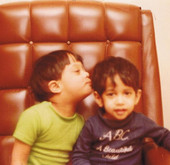
Dr. Vellody has a brother with Ds and a wonderful family with four children!  If you ever wondered what was going on in the picture (at right), it is little Kishore and his brother.  I think the chair was later used for the set of the Brady Bunch.
During the episode we discuss the following medical issues:
  • Heart Surgery – How to choose the right hospital/staff
  • The common cold for those with smaller nasal passages
  • Sleep Apnea – Sleep studies are important!  This can have chronic affects if left untreated.
  • The neck instability thing (Atlantoaxial Instability) – We learned a lot about this
    • It is much rarer than I thought (a few in a thousand)
    • They do x-rays to diagnose it but an x-ray is a poor tool
    • There are symptoms to look for – Dr. Vellody can spot them
    • Don’t worry about it so much, but don’t drop your kid on his head if you can help it.
    • DS Medical Registry
    • Health Supervision for Children with DS – Apparently our kids did come withinstructions!
Dr. Vellody has also started his own podcast to share his medical knowledge (which is how we found him!).  Have you ever left a doctor’s appointment and said to yourself – ‘I just hope I could remember everything he said’?  Wouldn’t it be cool if you could just go to his podcast and hear it all again while you were at the gym or driving in your car?  Well that all possible now.  Here is the link to his podcast in iTunes.  And here is the link to his web page (Children’s Hospital of Pittsburgh).
Thanks for listening!  Remember to go to iTunes and give us a great review and subscribe.  You can also leave us comments on this site!  Have a wonderful DS Awareness Month and a great time at your local Buddy Walk/Step Up event!
~Down Right Awesome Dads
Download Down Syndrome Radio, Episode #23.
Better yet…subscribe, rate us and leave a comment on iTunes!

Monday, August 12, 2013

Could it be a 'cure'? Breakthrough prompts Down syndrome soul-searching


from JoNel Aleccia from NBC News Blog:
In the 14 years since her daughter, Rachel, was born with Down syndrome, Jawanda Mast has always been clear that she’d change the condition if she could.
“I couldn’t love her more, but I would give almost anything to take away that extra chromosome,” the Olathe, Kansas, mom wrote on her blog. “While I may know she’s perfect, the world doesn’t.”
But when Massachusetts scientists announced recently that they’ve found a way to silence the chromosome that causes trisomy 21, also known as Down syndrome, it rocked Mast – and the rest of the disability community.
“It’s so hard to imagine you could actually do that,” Mast told NBC News. “Yes, I would take away the challenges, I would take away the health risks. But now I also stop and say, ‘Oh my goodness, how would that impact the rest of her?’”

Sunday, January 13, 2013

Why Down Syndrome Boosts Susceptibility to Other Conditions

from Science Daily.com:
A study led by UC Irvine researchers has revealed some of the underlying neural factors that explain why people with Down syndrome are more susceptible to Alzheimer's disease, diabetes and autistic spectrum disorders. Jorge Busciglio, associate professor of neurobiology & behavior, and colleagues analyzed the cellular and molecular mechanisms leading to oxidative stress and mitochondrial dysfunction in individuals with Down syndrome.
They found that this breakdown in energy metabolism within brain cells contributes to the higher probability of these other conditions.
Down syndrome occurs when a person has 47 chromosomes instead of the usual 46. Estimates suggest that 25 percent or more of individuals over 35 with Down syndrome show signs of Alzheimer's-type dementia. This percentage increases with age.
The incidence of Alzheimer's disease in people with Down syndrome is roughly three to five times greater than in the general population. Pablo Helguera, Jaqueline Seiglie and Michael Hanna of UC Irvine; Jose Rodriguez of UCLA; and Gustavo Helguera of Argentina's University of Buenos Aires also contributed to the study, which appears in the Jan. 8 issue of Cell Metabolism and was supported by the Larry L. Hillblom Foundation and the National Institutes of Health.

University of California - Irvine (2013, January 10). Why Down syndrome boosts susceptibility to other conditions. ScienceDaily. Retrieved January

Tuesday, October 9, 2012

How mosaic Down syndrome can be missed


by Shannon Blaeske from Lifes Litte Surprises:

Parents are crazy. Especially moms. And especially new moms. Every sniffle raises alarm, every odd movement or out of routine behavior causes suspicion. So it comes to no surprise to me that doctors have quick answers to all these tiny concerns. I am sure the pediatrician night hot lines ring off the hook all night long from worried moms over-reading into the common cold. But what happens when mothers intuition is right? What happens when the rare, not likely cause of the sniffle is the cause? What happens when doctors dismiss symptoms because they are unaware of what they may be indicating?

For two families, just that happened. Both Holly and Sarah knew certain things were not right with their daughters. Numerous small health concerns kept rising up, and each time, they were dismissed with the most common answers.  For Holly, the answers she was given for the cause her daughters constipation and projectile vomiting did not sit right. And for Sarah when her daughter ended up having a very rare congenital subglottic stenosis, she too questioned if something else could have caused it. But who were they to question doctors? They trusted their opinions. They trusted that they knew best.

Saturday, December 3, 2011

Celiac, Gluten and Down syndrome

People with Down syndrome are more likely to have Celiac Disease (CD) requiring a gluten-free diet. Below is a compliation of articles on this topic.


From Down Syndrome: Health Issues:
  • Studies in the 1990s indicated that children with DS are at a higher risk to develop CD than the general population. The reasons for that aren't entirely clear, but since children with DS are at a greater risk from auto-immune diseases, that CD represents another one of these type of diseases.
  • Children with DS who develop CD may actually have few symptoms at all, leading to what is called "silent" CD.
  • Since CD can show few to none symptoms in children with DS, why worry about it? Because if left untreated, CD can cause decreased growth in height in children. Untreated CD can also cause a type of cancer in the intestine called lymphoma. This cancer is a rare but serious outcome that appears in the later adult years.
  • Treatment is both simple and difficult: a gluten-free diet. All wheat, barley and rye products are off limits. Currently, it is recommended that oats be also eliminated from the diet at the beginning. They can be replaced in the diet as soon as the patient is doing better. In many cases, the symptoms of CD may lessen in as early as 2 weeks. The older the child, the longer it takes to come under control. CD is a lifelong disease; symptoms may from time to time subside to the point of the CD appearing to be gone, but the person must continue on the diet to avoid illness. The person may need vitamin supplementation to complete the diet.
from Celiac.com:
  • Children with Down Syndrome should be screened for celiac disease because there is a 10% incidence of the autoimmune disorder in this population. Screening for and treating celiac disease can improve the quality of life for children with Down Syndrome.
from Pediatrics:
  • Screening for a disease is appropriate if the disease has serious consequences, if before onset of the disease there is a detectable latent phase, and there exists a treatment that is more effective at an earlier stage. In patients with symptomatic celiac disease, a gluten-free diet for as little as 5 years can reduce or prevent gut lymphoma. Thus, with respect to gut lymphoma, celiac disease can be considered a premalignant condition. Furthermore, in a substantial proportion of cancer patients, the underlying celiac disease is not recognized until around the time of cancer diagnosis. Therefore, it would seem intuitive that identification and treatment of celiac disease at an earlier, asymptomatic stage would be even more effective.
  • The authors site growth failure as one of the common findings at diagnosis of celiac disease in children with Down syndrome. Impairment of linear growth becomes evident late in the course of a disease. One would expect that screening and, therefore, earlier treatment would prevent growth failure.
from dsmig.org:
  • If the person is more than 2 years old when the diagnosis is established the condition will be lifelong. Those diagnosed before age 2 years may have other conditions which mimic coeliac disease and therefore should be rechecked with further gluten challenge before school entry.
  • Relatives of people with celiac disease, sometimes called celiac sprue, have a higher possibility of gluten intolerance but may not be aware they are affected.
  • Joan Medlen, RD, author of The Down Syndrome Nutrition Handbook: A Guide to Promoting Healthy Lifestyles, is a leading resource for families of children with celiac disease. Know that you are not alone in dealing with the challenges celiac disease and gluten free living introduces into your child's life - there are well informed professionals and parents who are reaching out to others, remembering the adjustments they made in the early months after diagnosis.
  • It is natural for families of children with the dual diagnosis of Down syndrome and celiac disease to feel anxious or occasionally overwhelmed in the weeks following diagnosis. Your child may find changes in routines and diet difficult, but it's common for them to feel much better within weeks of starting gluten free living.
  • Frustration with extended family, staff at school, daycare or recreation programs can make it difficult to work out the changes that are needed for the health and well being of the child with CD. Sharing articles and medical information, and eventually writing up a one page information sheet for substitute teachers and parents of your child's friends, will help educate and inform the whole community.
from NDSS:
  • The incidence of celiac disease in children with DS ranges from 10% to 16%.  One reason children with Down syndrome have this disease is because of increased susceptibility to autoimmune diseases. In children with Down syndrome who are genetically predisposed to celiac disease, exposure to gluten causes an immunologic reaction in the lining of the small bowel resulting in flattening and thinning of the normal hair like projections (villi) of the lining. This is the part of the intestine which is the absorptive surface of the small bowel.
from Woman Gone Wise:
  • In my initial research of the gluten-free diet and special needs kids,  I learned kids who crave these gluten-laden foods have most likely become addicted to them.  There is an opiate effect that occurs and many parents have reported their own children went through withdrawal like symptoms when initially eliminating gluten.  Many children with autism had a surge in their behavior. The withdrawal effects are similar to addicts withdrawing from a narcotic.
  • New textures, flours made of rice and beans, crumbly breads; are all things families typically learn to adjust to with this new diet.  But then the behavior came.  Wild behavior.  AJ began tossing items across the room.  He couldn’t keep his clothes on.  He ran across the hall as quickly as he could, throwing his body into the door, then ran through the family room throwing his body into the back door.  He ran back and forth and back and forth slamming himself into the doors and walls.  His pain tolerance was even higher than usual.
  • I almost became frantic, until I remembered the possible withdrawal symptoms.  I reread every word and it was describing our boy.  Not every child with autism reacts with heightened symptoms, I believe it is a small percentage, and of course our family hits the jackpot again.  I kept him home from school the first week until his body adjusted and calmed down. 
also from Woman Gone Wise:

How will your child learn to make healthy new choices?
  • Make an accessible food cupboard or basket for your child.  Put their name on the cupboard and celebrate the cupboard as his or her own.
  • Label packages.  Highlight the words “Gluten Free” on the food packages with a highlighter or tape your own colorful label on the gluten-free product.
  • Label choices.  Make a picture board of healthy and fun gluten-free choices: fruit, crackers, yogurt, etc.  Tape the picture board on the outside or inside of the cupboard as your child is learning new dietary choices.
  • Label the refrigerator.  Dedicate a bin or shelf in the refrigerator which remains exclusively accessible for your child.  Clearly and colorfully label the shelf or bin.
  • Look for labels in the grocery store.  Go shopping together and read the gluten-free labels on food products.  When your child takes an item from the shelf ask, “Is this food gluten-free?”  Use your finger to point out the words “gluten-free”.  Then celebrate, “Yea! This looks yummy!  These crackers are good for you.  Let’s put it in the cart”.   The repetition of reading labels together will help your child get in the habit of looking for the familiar “gluten-free” words until one day he or she will be able to do it on their own.