Featured:

10 Things Parents of Children with Developmental Disabilities Should Know
June 2015
|

Wednesday, July 1, 2015
10 Things Parents of Children with Developmental Disabilities Should Know


Tuesday, May 26, 2015
Police Make Video to Help Teen with Down Syndrome Battling Cancer Meet Taylor Swift
By Kathy Ehrich Dowd from People:
Taylor Swift, we hope you're reading.
A 13-year-old superfan who has Down syndrome and is battling cancer really wants to meet her idol, and a police department that knows a thing or two about the power of the Internet has made a video that they hope will make her dream come true.
Delaware's Dover Police Department made international headlines in January when Officer Jeff Davis was recorded jovially lip-synching to "Shake It Off" while driving his cruiser.
The viral smash earned the approval of the pop star herself, who re-Tweeted the department's video. Her record company even sent the department tickets to the upcoming Taylor Swift concerts in Philadelphia on June 12 and 13.
Fan letters poured into the police department from all around the world, but one standout note hit close to home: The mother of Victoria Marsh of Middletown, Delaware, wrote to the officers and told them about her daughter, a dedicated Swiftie who has Down syndrome and was diagnosed with osteosarcoma, a form of bone cancer, in December.
Taylor Swift, we hope you're reading.
A 13-year-old superfan who has Down syndrome and is battling cancer really wants to meet her idol, and a police department that knows a thing or two about the power of the Internet has made a video that they hope will make her dream come true.
Delaware's Dover Police Department made international headlines in January when Officer Jeff Davis was recorded jovially lip-synching to "Shake It Off" while driving his cruiser.
The viral smash earned the approval of the pop star herself, who re-Tweeted the department's video. Her record company even sent the department tickets to the upcoming Taylor Swift concerts in Philadelphia on June 12 and 13.
Fan letters poured into the police department from all around the world, but one standout note hit close to home: The mother of Victoria Marsh of Middletown, Delaware, wrote to the officers and told them about her daughter, a dedicated Swiftie who has Down syndrome and was diagnosed with osteosarcoma, a form of bone cancer, in December.
Wednesday, May 20, 2015
SUPPORT THE DRAFT INCLUSIVE EDUCATION POLICY STATEMENT FROM THE U.S. DEPARTMENTS OF EDUCATION AND HEALTH AND HUMAN SERVICES
ATTENTION DOWN SYNDROME ADVOCATES
SUPPORT THE DRAFT INCLUSIVE EDUCATION POLICY STATEMENT FROM THE U.S. DEPARTMENTS OF EDUCATION AND HEALTH AND HUMAN SERVICES
The U.S. Departments of Education and U.S. Department of Health and Human Services recently released a draft policy statement on the inclusion of young children with disabilities in high-quality inclusive early childhood programs, and they are seeking public comment. This policy statement will send a message to states and districts that inclusive early education provides significant benefits to all young children, both with and without disabilities. This argument may also be extended toward inclusiveness in all phases of a person’s lifespan.
The U.S. Departments of Education and U.S. Department of Health and Human Services recently released a draft policy statement on the inclusion of young children with disabilities in high-quality inclusive early childhood programs, and they are seeking public comment. This policy statement will send a message to states and districts that inclusive early education provides significant benefits to all young children, both with and without disabilities. This argument may also be extended toward inclusiveness in all phases of a person’s lifespan.
Monday, May 4, 2015
Princess Diana and her godchild Domenica
from Hellow Magazine:
Princess Diana would be thrilled to have a granddaughter, according to her close friend Rosa Monckton. Shortly after hearing the news that Prince William and Kate Middleton, had welcomed a baby girl, the British businesswoman and campaigner took to Twitter to say how much her late friend would have loved the new arrival.
"How Diana would have loved a grand daughter," she simply wrote to her 2,280 followers.
The 61-year-old, who was the CEO of Asprey & Garrard until 2002, went on to retweet and respond to those who agreed with her on the social media site.
Rosa also uploaded a photo her daughter Domenica Lawson, who has Down's Syndrome, and who Diana was a devoted godmother to until her death in 1997.

This is not the first time that Rosa has spoken about the kind of grandmother Diana would have been. Back in July 2013 when William and Kate became parents to Prince George, Rosa wrote a piece for the Daily Mail saying Diana would have "relished the role."

"How Diana would have loved a grand daughter," she simply wrote to her 2,280 followers.
How Diana would have loved a grand daughter.
— Rosa Monckton (@MoncktonR) May 2, 2015
The 61-year-old, who was the CEO of Asprey & Garrard until 2002, went on to retweet and respond to those who agreed with her on the social media site.
Rosa also uploaded a photo her daughter Domenica Lawson, who has Down's Syndrome, and who Diana was a devoted godmother to until her death in 1997.
Here is Diana with Domenica. pic.twitter.com/NB1LQGz2vw
— Rosa Monckton (@MoncktonR) May 3, 2015
This is not the first time that Rosa has spoken about the kind of grandmother Diana would have been. Back in July 2013 when William and Kate became parents to Prince George, Rosa wrote a piece for the Daily Mail saying Diana would have "relished the role."
Sunday, May 3, 2015
'Time stood still': Students elect girl with Down syndrome as prom queen
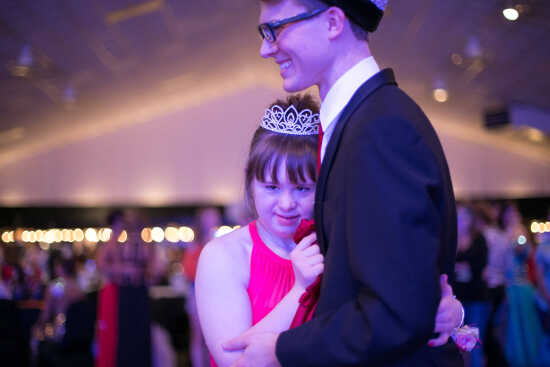
So, at Cape Girardeau Central High School's senior prom April 25, Carley's friends repaid that kindness.
As Carley stood on stage, wearing a long coral dress, her name was announced as this year's prom queen. The crowd roared with excitement.
"It was like time stood still," said Carley's mother, Tamilla House, as she recalled the moment. "When they called her name, it was like my focus was just on her. Like I was right there, up on stage with her, sharing in her excitement."
Carley, 18, has Down syndrome. And while she mostly attends a special needs classroom in high school, she also was in classrooms with all students from kindergarten through junior high.
"This allowed her to form true friendships and unique bonds with many students in her grade," Tamilla said. "Carley has maintained those friendships throughout the years."
A couple weeks before prom, seniors were using social media as a way to encourage others to nominate Carley for prom queen court.
"My heart melted just reading those (posts)," Tamilla said.
Subscribe to:
Posts (Atom)