Showing posts with label spread the word to end the word. Show all posts

Thursday, March 5, 2015

Special Olympics club encourages students to stop the use of the “R-word”

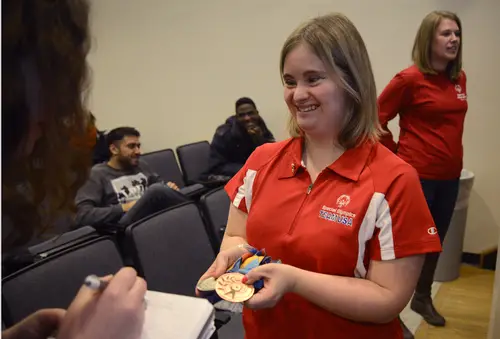
Kayla McKeon, a 27-year-old Syracuse native with Down syndrome, shared her experiences with the “R-word” as the Special Olympics Club’s guest speaker on Wednesday.
by Sara Swann from The Daily Orange:
On Wednesday at 8 a.m., members of the Special Olympics Club at Syracuse University spray-painted orange messages in the snow on the Quad to raise awareness of their “Spread the Word to End the Word” campaign.
The “Spread the Word to End the Word” campaign encourages people to stop the use of the “R-word,” or the word “retard(ed),” because it is “exclusive, offensive and derogatory.” Wednesday marked the annual day of awareness, which takes place the first Wednesday of every March, according to the campaign’s website.
In addition to raising awareness about the campaign, the spray-painted messages also invited the public to attend the Special Olympics Club meeting on Wednesday at 7 p.m. The meeting took place in Kittredge Auditorium, where Kayla McKeon, a 27-year-old Syracuse native with Down syndrome, shared her experiences with the “R-word” as the Special Olympics Club’s guest speaker.
“If you must call me something, please call me Kayla,” McKeon said in her presentation to an audience of about 50 people. “I am not a retard. I am differently abled.”

Sunday, September 21, 2014

Students fight against use of offensive slang

by Savanah Dickinson from The Daily Reveille: 
“Spread the Word to End the Word” encourages people to think before they say the “r-word,” and some at the University are pushing the national campaign on campus.
Youth with and without intellectual disabilities established the “Spread the Word to End the Word” movement at the 2009 Special Olympics Global Youth Activation Summit. Since then, the movement has spread to universities nationwide.
Deanna Rice, University doctoral candidate and event coordinator for the University’s branch of the campaign, said the movement hopes to eliminate the word “retarded” and replace it with respect.
“This is hurtful to people with intellectual disabilities and other developmental delays,” Rice said. “It not only hurts them but the family members who love them and also people like me that work with them in education and other support in the community.”
Graduate student Catherine Hauth presented a bill before Student Government Senate on Sept. 3 for “Spread the Word to End the Word.” Hauth encouraged each senator to take the pledge and pass along the message.
The bill passed unanimously. Rice encourages students to take the pledge to stop using the “r-word” at www.r-word.org. The movement also utilizes social media — @EndtheWordLSU on Twitter — to reach more students.
In March, “Spread the Word to End the Word” will hold a table-sit outside the Student Union to spread awareness with the hope that more students will take the pledge.

Wednesday, March 6, 2013

3/6/2013 Spread the Word to End the Word Day


Why Pledge?
The R-word is the word 'retard(ed)'. Why does it hurt? The R-word hurts because it is exclusive. It's offensive. It's derogatory.

Question: What is Spread the Word to End the Word?
Spread the Word to End the Word is an on-going effort to raise the consciousness of society about the dehumanizing and hurtful effects of the word "retard(ed)" and encourage people to pledge to stop using the R-word. The campaign is intended to get schools, communities and organizations to rally and pledge their support.

How to discuss the R-word with others.

Act Now!
Pledge your support to eliminate the demeaning use of the r-word.


                    TAKE THE PLEDGE NOW

What Can You Do Today?

In the News Check out some of the news highlights in the lead up to our big day of awareness. Share them with your social networks & friends!

Monday, March 4, 2013

Spread the Word to End the Word Video

This video was created by the Treasure Valley Down Syndrome Association in support of the Spread the Word to End the Word campaign, an on-going initiative from Special Olympics and Best Buddies to eradicate the derogatory use of the word "retard(ed)" from everyday use and promote the inclusion and acceptance of people with intellectual and developmental disabilities. Five siblings of individuals with Down syndrome in Idaho's Treasure Valley volunteered to help us spread the word that their brother or sister with Down syndrome is not defined by their disability. A big thanks to all those who helped us create this video by starring in it: Therese and Liam Murphy; Gabriela, Christopher and Mikaela Olmos; Tess and Isabelle Scott; Tegan and Madison Maestretti; and Austin Schaffer and Aaden Vranish. And a HUGE thank you to Sara Cox for producing the video, Alex Post who scored the original music, and our amazing videographer who volunteered his time to create this for us, Zach Johnson. Help us spread a message of acceptance and speak out against the r-word! idahodownsyndrome.org

Friday, June 8, 2012

Jane Lynch honored by the National Down Syndrome Society


from Ology.com by Victoria Garcia:
Comedian Jane Lynch is a woman who fights for what she believes in. She's known for fighting for the LGBT community and supports President Obama’s endorsement of gay marriage. However, this is not the only cause that Lynch supports.
This week Lynch was honored at the National Down Syndrome Society (NDSS) Annual Spring Luncheon. The event was hosted to celebrate people with Down syndrome and those who support them. Actor Chris Burke, known for his work on the ABC show Life Goes On, was also in attendance. NDSS is a non-profit organization whose mission is to advocate the value, acceptance, and inclusion of people with Down syndrome.
Similarly to her character Sue Sylvester on Glee, Lynch has shown support for down syndrome before and is a proud supporter of the campaign ‘Spread the Word to End the Word’. If you are unfamiliar with this powerful campaign, its main goal is to stop the everyday use of the word ‘retard’.
During the Wednesday luncheon that took place in New York City, Glee star Lauren Potter, who plays Becky on the show, also made an appearance by filming a video with Lynch in support of the campaign. Potter was unable to attend the luncheon but congratulated Lynch via video message. "The world would be a better place if more people saw beauty the way you do, and chose to recognize abilities, rather than disabilities," she said.
Congratulations to Lynch for being honored and supporting such an amazing cause! She's definitely an inspiration to all.

Saturday, April 14, 2012

Substitutes for the R-word

from About.com by Terri Mauro:

Often, when asked not to use the R-word, defensive speakers will reply, "You can't say anything these days!" But people, that's just a failure of imagination. Many, many, many substitutes for that offensive slur against individuals with intellectual disabilities are just a thesaurus away. In fact, I'll make it even easier than that -- in these pages, I'll share 225 words that can easily stand in for the R-word and make your vocabulary less limited.

First, a selection of words to substitute for the R-word when you want to be self-deprecating. Fill in the blank with one of the 75 choices below.

"I am such a(n) ______________"
  1. airhead
  2. birdbrain
  3. blockhead
  4. blunderer
  5. bonehead
  6. boob
  7. bubblehead
  8. buffoon
  9. bungler
  10. butterfingers
  11. child
  12. chowderhead
  13. chucklehead
  14. clod
  15. clodhopper
  16. clown
  17. crackpot
  18. cuckoo
  19. damn-fool
  20. dim bulb
  21. dimwit
  22. ding-a-ling
  23. ding-dong
  24. dingbat
  25. dip
  26. dipstick
  27. dodo
  28. donkey
  29. doofus
  30. dope
  31. dolt
  32. dork
  33. dullard
  34. dumbbell
  35. dum-dum
  36. dunce
  37. dunderhead
  38. fathead
  39. featherhead
  40. fool
  41. goof
  42. goofball
  43. goose
  44. ignoramus
  45. incompetent
  46. jerk
  47. joke
  48. jughead
  49. know-nothing
  50. kook
  51. lamebrain
  52. lightweight
  53. loser
  54. lowbrow
  55. lummox
  56. lump
  57. lunkhead
  58. meathead
  59. nincompoop
  60. ninny
  61. nitwit
  62. noob
  63. numskull
  64. oaf
  65. ox
  66. pudding head
  67. scatterbrain
  68. schlub
  69. schnook
  70. screwball
  71. slug
  72. turkey
  73. yahoo
  74. yokel
  75. yo-yo
visit the article for the full 225 Substitutes for the R-word

Wednesday, March 7, 2012

How to discuss the R-word with others

r-word.org
from r-word.org:

Having a conversation about the r-word can be difficult and often uncomfortable. Use the dialogues and tips below to help you successfully articulate why the r-word is hurtful and harmful in everyday speech.

Dialogue Scenario 1: When a friend/family member uses the r-word
Person 1:       I am such a retard; I forgot to get milk at the grocery store. 
Person 2:       Hey, I would appreciate it if you didn’t use the word retard around me anymore.
Person 1:       Oh don’t worry about it; it’s not a big deal.
Person 2:       It actually is a big deal, when you use retard as a synonym for stupid or idiot, you are saying that all people with intellectual disabilities are stupid, and that’s definitely not true.
Person 1:       But I’m not making fun of people who are mentally retarded, it’s just a figure of speech. It’s how I talk.
Person 2:       The thing is, when you use the R-word as slang, you really are hurting people with intellectual disabilities because of the negative connotation of your comment. The R-word has been associated with people with intellectual and developmental disabilities since its inception, so when you use the word in a negative context, you’re putting down people with intellectual disabilities, regardless of if you mean to or not.  
Person 1:       I appreciate what you’re saying, but it’s imbedded into my vocabulary. I couldn’t stop saying it if I tried. 
Person 2:       I’m not trying to tell you what you can or cannot say, but what I want you to recognize is that people with intellectual disabilities deserve respect, and using another word instead of the R-word is one step towards making them feel respected and valued in society.
Person 1:       Ok, I can understand it might be hurtful to use the word when a person with an intellectual disability is around, but why does it matter now, when I’m just hanging out and joking with my friends?
Person 2:       Using the R-word doesn’t just hurt people with intellectual disabilities, but it also hurt their friends and families. [Discuss personal story about why this is important to you]. Having seen the hurt that the R-word can cause, I know it’s important for me to take a stand and try to change the conversation. I hope you can understand why it hurts and upsets me when the R-word is used and why I would appreciate if you chose another word to use.
Person 1:       I’m sorry; I didn’t realize how much the R-word upset you. I will try to use another word instead.
Person 2:       Thank you for understanding.

Tips for a successful conversation:
  • Stay calm and collected, it will not help the other person see your point if you are angry and emotional.
  • Try to understand the reason he/she disagrees with you. Listen, be respectful and then provide a counterargument that highlights the harmful and hurtful effects of using the R-word.
  • Share a personal story about why the R-word is hurtful to you. Personal stories will help people more easily relate to what you are saying because it illustrates your personal commitment to the campaign.
  • If you encounter a question you are unable to answer, direct the individual to the Spread the Word to End the Word website (http://www.r-word.org/) to learn more about the campaign, Special Olympics and Best Buddies.

What can I do when I hear the R-word?

r-word.org

Making your own pledge to stop using the R-word and promote the inclusion and acceptance of people with intellectual disabilities is a terrific first step.  At some point however, we will all hear someone else use the R-word and think to ourselves – What do I do now?
It’s a tough question because each situation is unique, no one likes to be seen as “the word police,” and often times it’s just easier to let it go unnoticed and go on about your day.  However, now that you’ve taken the R-word pledge, you have a larger opportunity to be an agent of change in the world and speak up when you hear others use the R-word.

Below are some ideas, tips and resources for you to answer the question: What can I do when I hear the R-word?

Dialogue Scenarios

There are a lot of scenarios in which you may hear the R-word.  Here are some typical situations that depict a potential dialogue you can have to help someone understand why it’s important to choose more respectful language.  (Note: We welcome suggestions on additional scenarios, and user generated scripts or videos to provide in this space as resources.  Email us at mailto:info@specialolympics.org?subject=R-word%20Dialogue%20Suggestions)
Scenario 1:  When a friend or family member uses the R-word 
Scenario 2:  While collecting R-word pledges

Hearing the R-word in the Media

The R-word continues to be pervasive in mainstream media.  It is still used in television shows, movies, live television interviews and more.  The best way to create change in this space is to speak up, loudly.  When you hear the R-word used in the media, there are many things you can do to activate immediately.
  • Note down the time, channel and program information in which you heard the word.  
  • Try going online to get a clip of the usage.  Most networks have websites where you can view recent episodes and even select a specific clip to share.  You can also try Hulu.com or YouTube.com.
  • Search for information about the show (http://www.imdb.com/ is great for this). Find out who the actors, writers, producers and distributors are and write them!  Find out who the relevant network contacts are and write to them.  Find out who the advertisers are that support the show and write to them.  
  • Use your social networks to engage those same people and share your activities with the Spread the Word to End the Word social media outlets on Facebook and Twitter so the community at-large can activate.

Hearing the R-word in Person

You may hear the R-word used directly or indirectly, maliciously or non-maliciously, by a friend or a stranger, in a professional setting or on the street.  Every situation presents unique challenges and opportunities in deciding what you want to do after you’ve heard the R-word used.
  • Many people will immediately speak up and share that the word is hurtful and ask the user to please choose more respectful language.
  • Others who aren’t as outgoing may keep some of our branded cards on hand to pass out to someone who uses the R-word.
  • Some people engage people who use the R-word in a conversation asking them why they chose to use the word and inquire as to the exact meaning of the message they were trying to get across and them simply ask them if there is a word that conveys the same meaning but is less hurtful.
  • Often times people who have loved ones with an intellectual disability will preemptively ask friends or guests to be mindful of their language in recognition that some people simply aren’t aware of the hurt their words can create.  
There are many ways to handle many different situations.  We’ve put this exact question to our fans on Facebook before and have seen lots of different approaches.  Check out what they had to say.
Whatever your method of handling the situation when you hear the R-word in person it’s important that your put safety above all else and do not confront anyone with violence, or threats of violence.  The Spread the Word to End the Word campaign is about creating communities of respect and inclusion where all people are valued, even those who may disagree with our position, so it’s important to respect their opinions as you want them to respect yours.

Below are some basic tips to help guide you in having a conversation with someone who has used the R-word.

Tips for a successful conversation:
  • Stay calm and collected, it will not help the other person see your point if you are angry and emotional.
  • Try to understand the reason he/she disagrees with you. Listen, be respectful and then provide a counterargument that highlights the harmful and hurtful effects of using the R-word.
  • Share a personal story about why the R-word is hurtful to you. Personal stories will help people more easily relate to what you are saying because it illustrates your personal commitment to the campaign.
  • If you encounter a question you are unable to answer, direct the individual to the Spread the Word to End the Word website (http://www.r-word.org/) to learn more about the campaign, Special Olympics and Best Buddies.