Saturday, August 31, 2013

UK Swimmer Laura bids for more medals at Special Olympics


by Yonnie McInnes from The Daily Record:
BEING born with Down Syndrome hasn’t stopped 19-year-old Laura Logan from achieving sporting success.
Laura, from Coylton, Souyth Ayrshire, has already lifted around 100 swimming medals and is aiming to win more.
For on Tuesday she left for Bath along with 217 Scotland West athletes to compete in the National Special Olympic Games on Sunday.
Laura is one of eight athletes, seven swimmers, one 10-pin bowler and three coaches from Ayrshire who are part of the Sports for Special Needs’ team; Laura is part of Kilmarnock Jets Swim Team.
Sports for Special Needs coach Joan O’Sullivan said: “Laura has been a member of our club since April 2007, she trains at the Galleon Centre in Kilmarnock every Tuesday evening and has been doing additional training at Drumchapel in Glasgow with the Scotland West Swim Team on the first Sunday of every month since being selected at the end of last year.
“All athletes who wish to be selected for the team apply, then they have to go through a compatibility test to see if they fit the criteria and trials.
“On the first round there were 70 applications for 40 places on the swim team, 22 males and 18 females to be selected. So it was an honour for all successful chosen athletes to gain a position to swim for the West of Scotland at the Special Olympics.”
Laura has achieved all this despite hearing problems that have meant a lot of operations, as well as a heart defect for which she needs a yearly check-up.

Friday, August 30, 2013

For Kids With Special Needs, More Places To Play


by Robert Benincasa from NPR:
Remember running around the playground when you were a kid? Maybe hanging from the monkey bars or seeing who could swing the highest?
It wasn't just a mindless energy burn. Many have called play the work of childhood. Play teaches children how to make friends, make rules and navigate relationships.
But for kids whose disabilities keep them from using playgrounds, those opportunities can be lost.
New federal requirements under the Americans with Disabilities Act are changing the landscape for public playgrounds, requiring them to include equipment, materials and designs that provide children with disabilities the same play opportunities as typical children.
But as NPR sought to explore the effects of the new rules, it found that parents and advocates are making the real difference — not the federal government.
The higher cost of "inclusive" playgrounds means many local governments can't afford them. And in places that do offer the kind of shared playing experience contemplated by the ADA, a group of frustrated parents is typically behind it all.

Thursday, August 29, 2013

Children with Down syndrome are trained up by fire crew


by Matthew Edwards from The Swindon Advertiser UK:
YOUNG people with Down syndrome have been finding out all about the emergency services as they put out fires, cut people out of cars and drove around with the blues and twos on.
A group of young people have taken part in the Salamander Project and spent the week with the Wiltshire Fire and Rescue Service to experience a basic fire and rescue training course.
The programme, held at Drove Road Fire Station, encourages participants to work as a team, while building up confidence and self-esteem.
Yesterday the group put on a display of their new-found skills for family, friends and senior fire officers which included cutting casualties out of cars and climbing ladders to save a woman from a burning building.
Sixteen-year-old Stephen Thomas was taking part in his fourth course and said that he had grown in confidence since he first started.
He said: “I have enjoyed the course because of all the different things we have done. My favourite part was at Coate Water where I was able to jump in the water.

Wednesday, August 28, 2013

Playgrounds For Everyone: A community-edited guide to accessible playgrounds

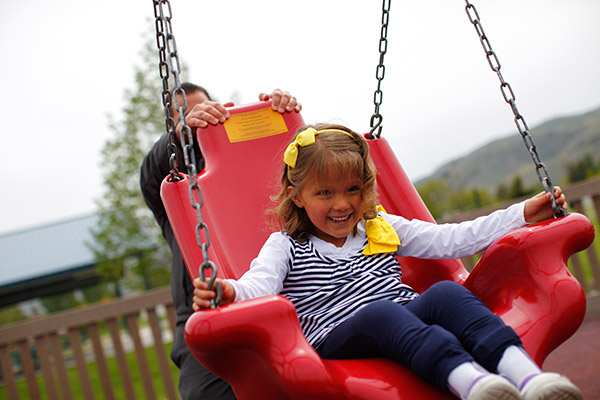
Accessible swing

from NPR:

A community-edited guide to accessible playgrounds. So far, we've identified 1,525. Help us find more!

On Your Smartphone: Visit npr.org/playgrounds

Why Accessible Playgrounds?

Because kids in wheelchairs can't play on playgrounds covered with wood chips. And children with muscular disabilities can fall out of swings that lack sides and backs. Or a child with vision or hearing problems can benefit from equipment specially designed for play alongside friends, siblings or any other child.

New federal requirements define playground accessibility as a civil right. And under those rules, playgrounds built or altered after March 14, 2012, are required to have wheelchair-friendly surfaces and equipment that helps kids with physical challenges move around.
Want to know more? Read our story.

You Can Help!

A comprehensive database of inclusive and accessible playgrounds does not yet exist, but you can help us create one.
  1. 1 Go to your playground. Does it have any of the features listed below?
  2. 2 Search to see if we have it listed. (See "Find An Accessible Playground" at the top of this page.)
  3. 3 Add your playground, or edit to add missing information.

Tuesday, August 27, 2013

A Mother and Her Child in the World of Down Syndrome in Nepal


by Michael Rosenkrantz from The Huffington Post:
Dr. Lalita Joshi, a retired Br .Gen. of Nepal Army Medical Corps with strict principals, simple and honest is driven by a deep love for her son Ashish, born some 22 years ago with Down Syndrome. She married Dr. Prabhu Joshi, an anesthesiologist, in 1980 and their first son, Amit, was born in 1981. Amit completed his MBA in the US and is now working for an investment company in Nepal. In 1989 Lalita became an OB-GYN.
In 1991 their second son Ashish was born. For 14 days Ashish was in NICU before he was able to come home. He possessed some facial features of a child with Down Syndrome and although the family suspected something, there were no real issues. When Ashish was three the family went to Madras for an elder sister's renal transplant. At that time Ashish was tested and it was confirmed that he had Down Syndrome. Fortunately for the Joshi's, Ashish has been accepted by all family members who refer to him as Lakshan Kobacha or lucky child.
The most common type of Down Syndrome is called Trisomy 21, which accounts for about 95% of people affected. Ashish has a less common type, known as Mosaic, which is a milder form of Down Syndrome enabling him to function at a much higher level.